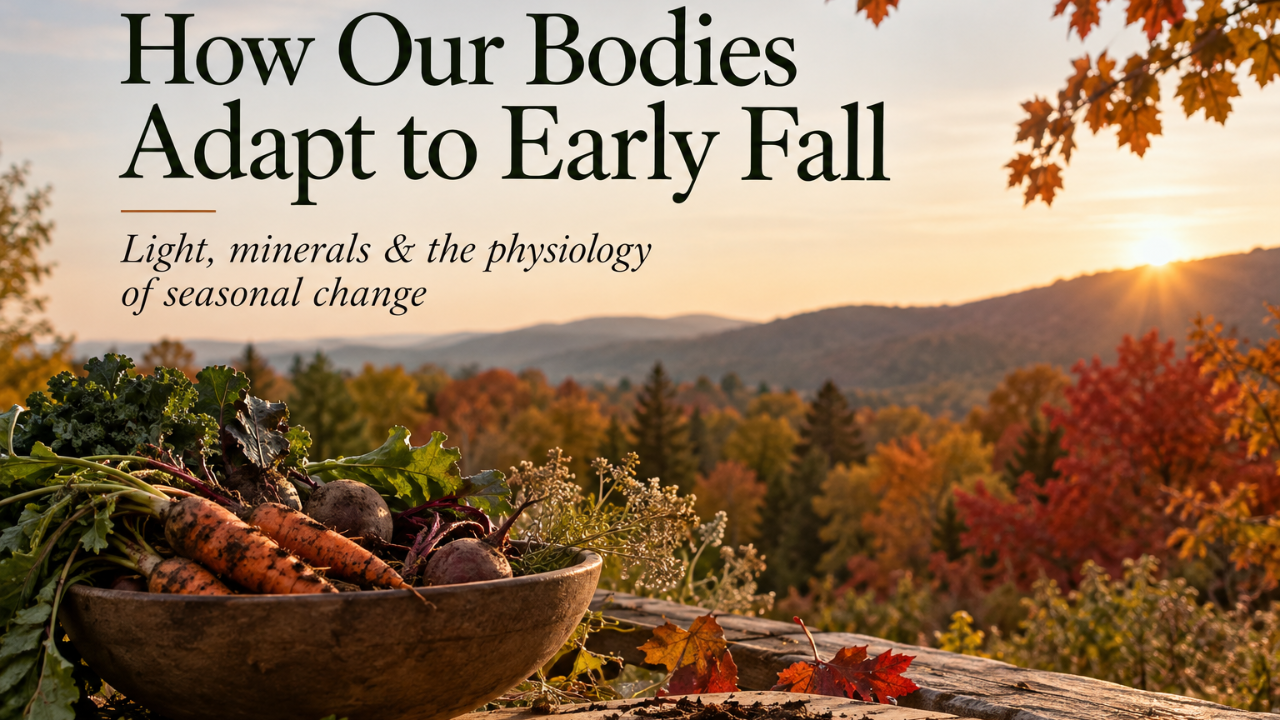
How Our Bodies Adapt to Early Fall: Light, minerals & the physiology of seasonal change
A Rewilded Wellness approach to seasonal health
What happens during a seasonal transition, and how our relationship with our foundations can change as we become more capable of responding to our bodies.
We crossed the fall equinox on September 22, the start of Libra season and the real turn into autumn. Most of us learned that the equinox is the day when daylight and nighttime are equal. That's close to true, not exact — the actual moment of equal day and night lands a few days after the equinox itself, because of how sunlight bends slightly through the atmosphere. It's a small nuance, and I'm not going to dwell on it. But it points at something worth sitting with as we move through the opening days of this season: even the light itself doesn't hit a fixed balance point and hold there. It keeps moving. Shorter days keep arriving after it.
That's where we are right now. We've crossed into fall. That doesn't mean we've landed somewhere stable. It means we've started adapting to a new set of conditions, and that adapting is still actively happening in your body right now, whether or not you've noticed it yet.
I noticed it this year because the weather turned on me fast. The temperature dropped hard and quickly right around the equinox, and I felt myself tighten in response, less loose, less fluid, more contracted than I'd felt even a week earlier. I can't tell you exactly what was happening in my tissue. What I can tell you is that I noticed the change in myself almost exactly when the season changed, and that noticing is the whole point of this piece.
Ayurveda has a concept called ritusandhi, the junction between seasons, and it traditionally gives special attention to the seven days before a seasonal change and the seven days after. I find that framing genuinely useful, not because I can prove anything about adaptive capacity being tested in some measurable way, but because it names something I recognize: the handoff itself, not just the destination, as a distinct and important stretch of time.
That's really what I want to talk about here. Fall isn't one long static condition. It has phases, the same way any season does. Right now we're at the very beginning of it, the threshold, not the version of fall most people picture when they hear the word. Most of us jump straight to the middle or the end: Halloween, Thanksgiving, the clocks changing, cold and flu season. That's not where we are. We're at the opening. The season is still establishing itself, and so are we. So let's talk about what that opening actually looks like. What is changing, this early in fall, and what do you need to know about this specific stretch of the year?
Libra season, and the doorway it opens
We just moved into Libra season. In traditional medical astrology, Libra is associated with the kidneys and the lower back. Whether or not you use astrology as a health framework, I find that symbolism interesting at this particular threshold, because the kidneys give us an extraordinary physiological example of what balance actually means. They aren't built to hold one setting. They're built to constantly renegotiate, how much water to keep, how much sodium to hold onto, how much pressure to maintain, based on what's actually happening around you right now.
That's the thread I want to pull on: balance is responsive, not static.
What's actually shifting in your fluid and mineral physiology right now
July and October present your body with genuinely different fluid and electrolyte demands. Hot weather, prolonged sweating, and higher activity levels create one set of losses and one set of regulatory responses. Cooler weather, reduced sweating, and different thirst, activity, and vascular conditions create another. Your kidneys continually regulate sodium, potassium, and water according to what's actually happening around you, using hormones like aldosterone and vasopressin to make those adjustments in real time.
Blood pressure moves with the seasons too, with population studies consistently finding higher average blood pressure in colder months than warmer ones. Cold-induced vasoconstriction is one contributor: as your blood vessels narrow in response to cold, vascular resistance increases, and your heart works against more pressure. It's not the whole explanation for why blood pressure shifts seasonally, but it's a real and well-documented piece of it.
Most people don't think about fluid and mineral needs as something that can change with context. The modern electrolyte industry hasn't helped with that. You've probably seen the same packet marketed to you in every season, the same sodium-to-potassium ratio, sold like your relationship to salt and water is a fixed constant you correct once and maintain forever. It isn't. Why would we turn electrolytes into another static health rule when electrolyte balance itself is dynamic?
I don't use hydration and electrolytes exactly the same way all year anymore. I lean on my electrolyte drink mostly in summer, and reach for it other times of year when it genuinely feels appropriate, not on a fixed schedule. Most of the time now, minerals and hydration show up throughout my day in other ways: mineral-rich water, herbal infusions, broth, salting my food well. That took time to get here. When I first started paying real attention to my own hydration and mineral status, I needed more structure, more deliberate tracking, more conscious effort to build the habit at all. Over the years, as I built experience and capacity, a lot of that structure became integrated into how I already eat and live, so I don't have to consciously manage it the way I once did. That doesn't mean the original structure was wrong, or that everyone should abandon a starting practice the moment it starts working. It means a foundation doesn't have to stay a permanent rigid rule just because it was useful during one phase. Rewilding isn't about trading structure for intuition. It's about letting knowledge, observation and lived experience start working together, so something that began as a deliberate practice can become part of a more responsive relationship with your body.
None of this lands the same way on everyone, because our actual exposures are different. Air conditioning changes how much summer heat you encounter. Heating changes how much cold you experience. How much you're outside, how active you are, how much you're sweating, what you're eating and drinking, all of that changes the conditions your body is responding to. Season matters, but so does the life you're actually living inside that season.
Light gives us another example
Light is the main timer your nervous system uses to know what time of day, and what time of year, it is. This is basic circadian biology. Your eyes take in the changing quality and duration of daylight and use it to set your internal clock. That clock doesn't just govern when you feel alert or sleepy. It organizes a whole cascade underneath that: the timing of your cortisol and melatonin rhythms, your appetite and meal timing, and how your body handles glucose across the day. Light isn't just telling you when to feel tired. It's one of the primary inputs your body uses to organize its physiology across each 24-hour cycle, and that input is changing right now, every single day, as the days get shorter.
Here's where it gets complicated. Most of us aren't living inside the natural light environment that shaped this system anymore. Our bodies can only respond to the light information they're actually receiving. Indoor lighting is a tiny fraction of the brightness of actual daylight, even on a gray day outside. If you're waking up under artificial light, commuting in a car, and working inside under fluorescents or LEDs, your circadian system is getting a deeply muted version of the signal that's actually shifting outside right now.
Why we stopped noticing any of this
Your circadian system evolved around a very specific kind of light environment: bright daylight during the day, real darkness at night, both shifting gradually and predictably across the seasons. That's not the environment most of us live in anymore. Air conditioning changes our exposure to heat. Heating changes our exposure to cold. Indoor living changes our exposure to daylight. Artificial evening light changes our exposure to darkness. Grocery stores flatten seasonal food availability into sameness. None of that is a moral failing, and I'm not interested in an ancestral-good, modern-bad story here. We've built an environment that modifies our exposure to the natural cues our bodies were built to read.
My garden hasn't gotten any of this memo. Right now I'm pulling storage crops out of the ground, roots and tubers, things built to carry through the dark months rather than get eaten fresh this week. The plants outside my door are reallocating their resources. Some are dying back. Seeds are forming. Light is declining, and they're responding to it in real time, with no debate about whether the season has changed. Meanwhile we can walk from a seventy-degree house to a car to a grocery store to an office, and buy strawberries in January. Food is changing right now too, and there's a whole conversation there I'm saving for later, but even without getting into it, the garden makes the larger point on its own: the environment has genuinely shifted, whether or not we've been paying attention.
What this actually asks of you
Sun still matters. Hydration and minerals still matter. Sleep still matters. Movement still matters. None of that changes. What changes is how you meet each of those foundations right now, because the light you're getting sun through has changed, because the conditions your kidneys are responding to have changed, because the dark window you're sleeping inside of has changed.
Every seasonal transition is also a natural point to take stock, the way I do in the garden this time of year. I'm not just harvesting. I'm noticing what grew well and what didn't, what's worth storing, what's finished its cycle and needs clearing, what I want to carry forward into the next stretch. I'm not suggesting our bodies go through some prescribed autumn detox or shedding phase. I'm talking about something much simpler: the conditions around us have changed enough that this becomes a useful moment to notice what still fits and what doesn't.
The question isn't what new rule you need for fall. It's whether you're noticing that the conditions have changed, and whether the way you're tending your foundations has room to change with them.
Balance isn't a setting we reach. It's something our bodies are continually negotiating.
This is also why I'm returning to something I started earlier this year. Back in the spring, I put together a six-part series called The Terrain Map, going into some of the deeper physiology underneath the patterns I see over and over in my work: microbial diversity, motility, gut barrier function, inflammatory signaling, the relationships between systems we usually talk about separately. I never considered that map finished. I've spent another six months working with clients, looking at labs, watching my own patterns, and living inside these questions, and I want to go back in with more territory under my feet. Starting with the next episode, I'm continuing The Terrain Map, and we're going deeper.
And that same way of thinking is at the center of how I work with clients. If you've been collecting health information for a while now, testing, supplements, recommendations from a dozen directions, and you still don't know what actually matters for you right now, that's exactly the gap this kind of work is for. Testing can hand you data. The real work is learning what that data means in the context of your body, your history, and what we learn as we watch your patterns over time. I currently have four October openings for Minerals & Microbes if you're ready to do that work with me directly.
Stay empowered with my weekly updates!
If you enjoy reading my posts, please consider being a part of the tribe that is being built here. You're information will not be shared.
